• Booklish
  • Index
  • Blog
  • Shelf
  • About
  • Ratings
  • Contact
Menu

Booklish

Delectable reads for bibliophiles
  • Booklish
  • Index
  • Blog
  • Shelf
  • About
  • Ratings
  • Contact

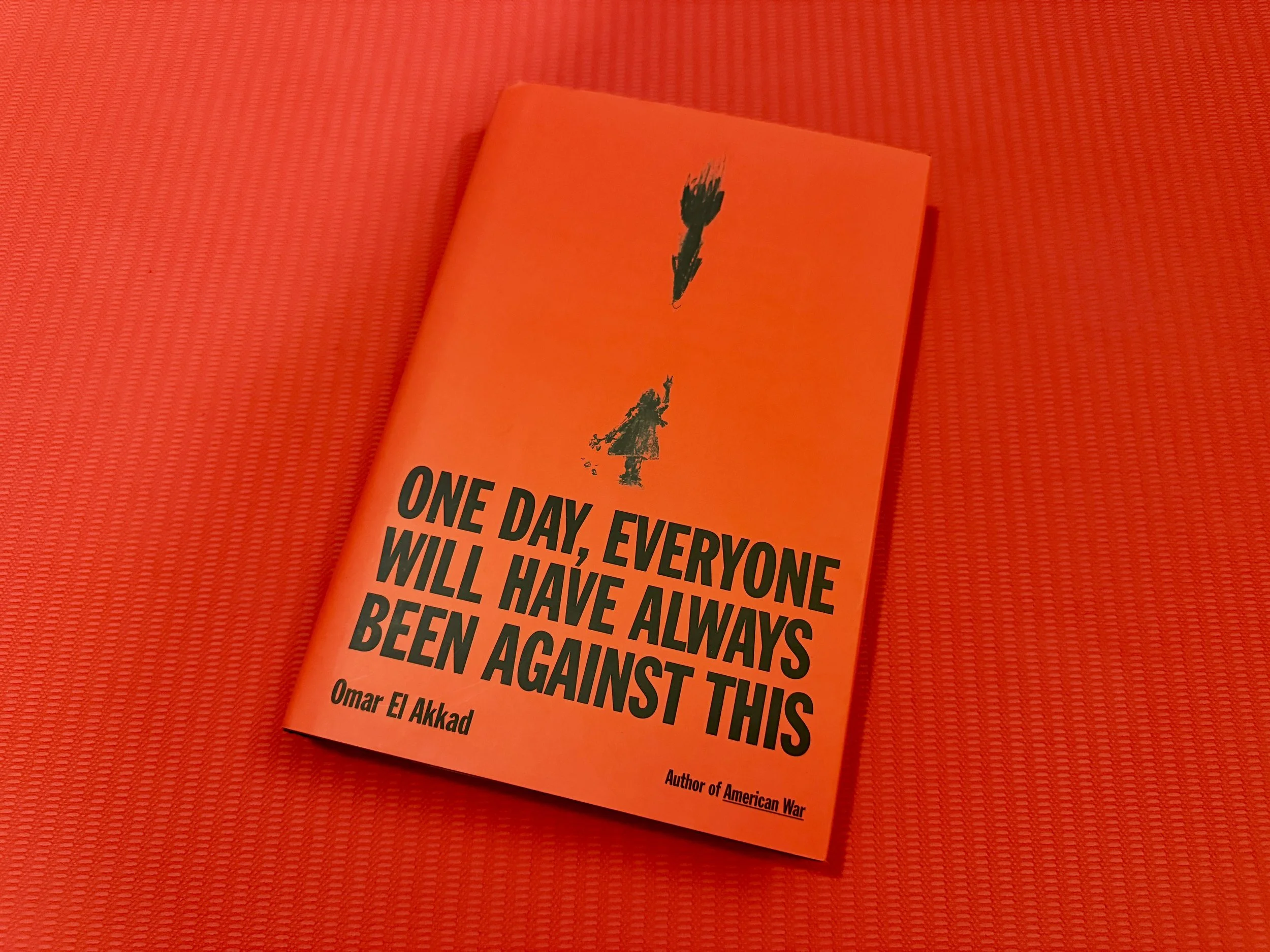
‘One Day, Everyone Will Have Always Been Against This’ by Omar El Akkad

One Day, Everyone Will Have Always Been Against This

January 12, 2026

Review: 5 stars

Omar El Akkad’s latest non-fiction book examines power, violence, and the language used to describe them, with significant attention to Gaza. Drawing on journalism, history, and personal reflection, the book considers what responsibility remains for those who witness events from a distance.

In particular, when the author takes a more journalistic and rhetorical lens on the genocide in Gaza, he makes a poignant point about the truths of the violence that occurred and who the victims were. What is undebatable is that lives were snatched too early, rendered collateral damage in the ongoing theatre of revenge. “When the past is past, the dead will be found to not have partaken in their own killing. The children will not have pulled their own limbs out and strewn them all over the makeshift soccer pitch.”

El Akkad fixates at length on the role of language in covering this conflict—the contortions Western media goes through to avoid blame, to preserve a veneer of objectivity, while failing what he argues is journalism’s moral mandate: to report facts. “Accidentally, a stray bullet found its way into the van ahead, and that killed a three- or four-year-old young lady,”reported by a British newscaster, is a sobering example of how traditional media cannot bring itself to speak forthrightly about a toddler being murdered at a military checkpoint.

I do not come to this book as an expert. My understanding of Israel–Palestine largely stops at high school history, and I would not claim intimacy with the full scope of events since October 7, 2023. What unsettled me most about El Akkad’s writing was not simply what I learned, but what it revealed about the narrowness of the viewpoints I tend to encounter. I am often spoon-fed stories from Facebook, YouTube, and other social media algorithms that quietly reinforce what I already believe - or think I know.. When I linger too long on a video or a post, those moments are already reshaping what my scrolling will reveal next, and I often find myself snapping back to what is safe, known, and accepted.

In the true spirit of setting New Year’s resolutions, I found myself wondering what El Akkad’s call to action might be in the face of such pain. His concept of “negative resistance” was particularly compelling—almost a foot-in-the-door path for bystanders who want to do more but are scared to start. He defines it as “refusing to participate when the act of participation falls below one’s moral threshold,” including seemingly small acts such as changing which businesses we consume from or refusing to attend certain events. It struck me as a practice many people with strong moral compasses already exercise: the deliberate introduction of friction into one’s life, a willingness to inconvenience oneself in the service of something larger.

I am grateful that I read this book as my first of 2026. It was an abrupt reminder to question what I see and hear, and to intentionally seek out divergent perspectives in order to understand any situation more honestly. I exercise this instinct readily in my professional life, but my capacity for active curiosity in my personal life has likely atrophied. In its place, another muscle has likely grown stronger: indifference. Perhaps this is true for many of us, conditioned by COVID, by constant crisis, by the daily shocks of modern news. As El Akkad writes, “No atrocity is too great to shrug away now, the muscles of indifference having been sufficiently conditioned.” This book does not allow us to shrug.

In current events, non-fiction Tags war, national book award, palestine, journalism, 5 stars, emotional

‘The Great Believers’ by Rebecca Makkai

The Great Believers | poignant, empathetic, engrossing

January 21, 2020

Review: 3 stars

I embarked on a spree of reading National Book Award winners and finalists, given my luck with 'A Little Life' and 'Pachinko', which were both 5-star reads for me. I was excited to have a chance while on vacation in Italy over the summer to read 'The Great Believers' by Rebecca Makkai.

'The Great Believers' is jointly told by Yale Tishman, a gay art curator in 1980s Chicago, and Fiona Marcus, Yale's friend, who travels to Paris in search of her estranged daughter. It is a story about those whom we've lost, and those who are left behind - and the debate over which constitutes the more tragic life lived. The novel anchors around the friendships, betrayals and the inexorable march of death as AIDS claims one life after another. The novel's intensity reflects the pacing of a horror film; the reader is constantly puzzling over which character's actions will drive him to be the next victim of the pandemic. Fiona, who ends up being an end-of-life character to many of the friends over time, remarks at one point that "they were walking every day through streets where there had been a holocaust, a mass murder of neglect and antipathy". I invested heavily in Yale's character, whose sense of morality and nobleness appear to be a salve against the affliction felling his dearest friends. We travel with him as he experiences heartbreak, success and failure, all the while fearing what his eventual diagnosis will be.

Makkai has resurrected many survivor stories from that period, and woven them into a two-part narrative that commemorates those who were lost and never fully grieved over given social stigma of the time. The novel is well researched, respectful and successfully balanced between male and female perspectives.

Overall, I found Yale's plot more compelling and emotionally arresting than Fiona's, and caught myself several times reading rather quickly through Fiona's narratives. That said, this was a solid, sobering read for those interested in contemporary historical and LGBTQ fiction.

In fiction Tags LGBTQ, AIDS crisis, NYT best book, art, coming of age, 3 stars, national book award

Killers of the Flower Moon by David Grann

Killers of the Flower Moon | thrilling, provocative, sickening

September 1, 2018

Review: 4 stars

'Killers of the Flower Moon' was the February pick for the 'Now Read This' book club that I've been following. After a long binge on fiction, I felt I was due for some nonfiction reading. Luckily, I walked into the BMVQ bookstore, and saw the hardcover edition of this novel for over 50% off - I seriously love that bookstore. 

This book got me fired up. I was surprised by how outraged and indignant I felt as I read about the chilling conspiracy that led to a near-decimation of the Osage Indians during the 1920s in Oklahoma. The novel follows Tom White, a detective assigned by J. Edgar Hoover to solve the onslaught of mysterious Osage Indian deaths. What makes the murders all the more curious, is the fact that the Osage Indians were the wealthiest people per capita in the world at the time, given the proceeds from their headrights.

This book is meticulously researched, and enriched by the interviews, photographs, press clippings, and recorded conversations that Grann stitches together to evoke the Wild West atmosphere of the times. Justice was often taken into one's own hands (particularly rich, white hands), and meted out carelessly, with the exception of White's hunt for the Osage murder masterminds. Grann paces the plot masterfully, raising pulses when key witnesses and enforcement officers are conveniently dispatched just as they uncover vital clues. The cast of characters - the Osage, their white spouses and guardians, cowboy vigilantes, doctors, and nascent law enforcement - are dynamic, and Grann keeps you guessing until the end as to who the villains truly are. 

One fact that infuriated me was how many of the Osage Indians, despite their supposed riches from oil, were in fact quite destitute. This is because many Osage were assigned white guardians to manage their money and to dole out their meagre allowances, if they were deemed incompetent (which many were, just by way of their ethnicity). This transgressive appropriation of wealth was not secreted away - rather, it was a oft-stated goal amongst notable white society men to amass as many guardianships as possible, as a means to substantially increase their personal wealth. Marriage was another means to wealth. Ernest, the husband of Mollie, one of the main Osage characters, says in a statement: 'I don't work. I married an Osage'. It is hard to believe that this massacre - dozens of Osage - was swept under the rug of American history and unearthed only now for mainstream consumption. 

This book prompted me to consider the state of Aboriginals in Canada, and in what ways their stories are still untold to this day. We read headlines about how a teenage couple, the first in their families to graduate high school, were murdered by a jealous cousin, or how First Nations populations are more than three times likely to die prematurely due to drug or alcohol-related causes than non-Aboriginals. So much tragedy is already in the public sphere, but how many countless injustices have been conveniently forgotten, with no historian to archive or give weight to them? 

I highly recommend this book to anyone looking for a sobering, real-life thriller. Grann has done a mighty service by sharing this convincing, riveting story with us.

In non-fiction, history Tags true crime, thriller, now read this, national book award, 4 stars

Sing, Unburied, Sing by Jesmyn Ward

Sing, Unburied, Sing | timely, tragic, soulful

August 7, 2018

Review: 3 stars

'Sing, Unburied, Sing' was the first pick of the 'Now Read This' bookclub. It has also been awarded the National Book Award and appeared in a number of Top 10 Books of 2017 lists. Needless to say, it's been on my to-read list for quite awhile, and I dove into it during a family vacation to Santa Cruz. 

The novel is a railroad track with two parallel stories - one involving teenage Jojo, his toddler sister Kayla and a road trip with his mother Leonie to retrieve their father Michael from Parchman penitentiary; the other follows River, Jojo's Pop, and his time own time at Parchman decades earlier. Throughout, these parallel tracks cross, as spirits from the past - Richie, Pop's fellow inmate, and Given, Leonie's deceased brother - assert themselves on the protagonists' reality, insistent on their own agendas. 

Ward's writing modulates easily to craft each narrator's unique voice. It is effortless to empathize with Jojo in his role as Kayla's protector from a seemingly deadbeat, drugged-up mother. Similarly, I can easily meld myself into Leonie's conscience, urging her to love her children right, to be more than what circumstances have defined her to be. Ward effectively puts forward her thesis - that the restless souls of so many wronged black men and women are actively invading our present consciousness, influencing the actions of their ancestors generations later. The corpses are buried but their stories of injustice linger, demanding witness and reparation. Each character in the novel perceives these spirits to different extents, but not one is immune to the consequences of these African American lives. This is most poignant during the scene when Jojo and his family are pulled over by a cop, and Jojo, an unarmed black teenager, stares down the barrel of the officer's pistol for no good reason at all. It is a nightmarish history repeating itself again, different scenery, different weapon, same tragedy. 

Ward's novel is creative, unflinching and timely given our social struggle with ongoing racism and police brutality, particularly in the U.S. While I felt her novel was highly successful, for some reason, the story was less resonant with me. Perhaps I am not the right reader, in the wrong country. While my opinion and rating of the novel may be debatable, I do feel however that it is an important contribution to the prevailing discussion on racism. 

In fiction, current events Tags black literature, national book award, now read this, 3 stars

A Little Life by Hanya Yanagihara

A Little Life | tortured, unforgettable, compulsive

July 28, 2018

Review: 5 stars

I recently discovered the Queen Street BMV store in Toronto, where you can buy new (and recently released) books for 10-50% off list price. As usual, I was taking my baby out for an afternoon stroll and decided to pop in to find my next read. 

I thumbed through the stacks of popular reads on display, hesitating on "Americanah", before my eyes wandered to "A Little Life" on the staff picks shelf. The novel is often described as a portrait of the friendship between four men, and it piqued my interest since I thought I could gain insight into the mysterious world of male relationships. 

I was forewarned by Kevin, the staff recommender, that this would be a heavy read - one that I would need to mete out over days, if not weeks. I had felt the same way about "A Fine Balance" by Rohinton Misry, one of my favourite books, so readily jumped at the challenge. 

How can I appropriately synthesize this book?

Intensely, compulsively readable and plot-driven. Emotionally draining and replenishing. I found myself rushing through sentences, and then abruptly closing my eyes to abate the inevitable tragedy I knew would transpire several lines down. My heart chilled and physically ached as Jude tentatively unfurled his past and as he reviled and hacked at his own body. I blinked back tears during the small domestic moments and effortless gestures of affection between Willem and Jude. I raged against Caleb and his monstrosity. I reflected on my own friendships and how at a loss I was when dear friends have questioned their self-worth or will to live. I had to steel myself constantly for the next paragraph, the next page, the next chapter, for the onslaught of pain, misfortune and sorrow that I knew might obliterate the pockets of warmth that enveloped the characters just short pages ago (especially during "The Happy Years" period). 

It is an emotionally difficult read. Yanagihara distils the essence of being a friend, a parent, an enemy to yourself, and reveals it through small thoughts, small feelings, small actions. It speaks truths and assaults your lack of creativity - for there are so many different lives, so many different kinds of pain, that we cannot begin to imagine. She gets it so right, and stumbles so infrequently that it is difficult for me to understand how she conceived of this tale and its details. The addictive cycle of hurt, intervention, half-hearted appeasement and willful pretending is likely one that rings true for many friendships who have endured through pain. 

This book is a gift - a story that I thought about before I went to sleep and as I was on vacation in Vancouver (and cursing myself for leaving it behind in Toronto). It will stay with me for a long time, and will be a book that I consistently recommend to all serious readers. 

In fiction Tags relationships, heavy read, national book award, LGBTQ, 5 stars

The Leavers by Lisa Ko

The Leavers | realistic, cultural, sensitive

July 3, 2018

Review: 2 stars

I was perusing the NPR top books of 2017 list and came across Lisa Ko's 'The Leavers'. I've been wanting to read more from Asian writers ever since I read Celeste Ng, so picked this novel up from Queen Street Books in Leslieville (a great spot). 

'The Leavers' is centred around the mother-son relationship of Polly and Deming, and the mystery behind why Polly suddenly vanishes one day. As we learn through flashbacks, Polly forged her own path to New York City from rural China, relying on her ambition and resourcefulness. However, upon arriving at the doorstep of the American Dream, she falls into the trap of many first-generation immigrants - working long, toxic hours at a nail salon, with her meagre paycheck doled out for basic necessities. The dissonance between the beautiful, independent life she has imagined for herself, and the harsh grey dependency of reality is one of Polly's key internal struggles. 

The novel nicely details the small moments of warmth that envelop mother and son amidst their battles for financial stability and belonging in the concrete jungle. It is also largely effective in portraying the identity crisis that Deming faces as he becomes 'Daniel Wilkinson' to his adoptive parents, Kay and Peter. Deming reflexively responds to triggers from his Chinese childhood - the intoxicating aromas of xiao long bao and lilting intonations of Mandarin conversations, while Daniel immerses himself in a life of self-described comfortable mediocrity with music as his only escape. Both lives beckon to him, and repulse him simultaneously.

I also enjoyed how the novel dove into a controversial notion in our society - the mother's right to be selfish. When we discover Polly's actual fate, and the battles she fought against herself as a new mother, I truly emphasized with her character's dilemma. To nurture a self that is separate from your children is difficult as a parent, yet this is a desire that I think many women (and men) face. Most of us acquiesce to the popular perspective that we should sacrifice our whole self in order to be a good parent, and that the deeper the sacrifice, the more perfect our love. However, I think this is worth debate, and that the balance between self and selflessness is different for each one of us. 

While I enjoyed many of the themes, there was something that fell short for me. I was sufficiently absorbed in the plot, but it was difficult for me to truly connect at an emotional level with the characters, particularly with Deming. Many of the reviews celebrated how timely and essential a novel this is, given the Trump administration's immigration stance. While the issue is broached in the novel, I feel as though deeper exploration of it was warranted in order for this to be celebrated as a political statement. I think there was also further richness left untapped in Kay's experience as an adoptive mother - the ease that she was relegated to a temporary stand-in seemed cold and underdeveloped. 

Overall, it was a promising read, but I felt that an author like Celeste Ng was more deft at handling the Asian American identity struggle, and would recommend her books over this novel. 

In fiction, current events Tags motherhood, family, national book award, asian literature, immigration, 2 stars

Latest Posts

Featured
science fiction, apocalypse, LGBTQ, romance, culinary, 4 stars, asian literature
Land of Milk and Honey
science fiction, apocalypse, LGBTQ, romance, culinary, 4 stars, asian literature
strong female lead, palestine, new york city, NYT notable book, identity, 4.5 stars, classism
The Coin
strong female lead, palestine, new york city, NYT notable book, identity, 4.5 stars, classism
war, national book award, palestine, journalism, 5 stars, emotional
One Day, Everyone Will Have Always Been Against This
war, national book award, palestine, journalism, 5 stars, emotional
fiction, mid-life crisis, healing, books, korean lit, 4.5 stars
Welcome to the Hyunam-Dong Bookshop
fiction, mid-life crisis, healing, books, korean lit, 4.5 stars
3 stars, Japanese literature, crime, mystery, love
The Devotion of Suspect X
3 stars, Japanese literature, crime, mystery, love
fantasy, apocalypse, life & death, family, los angeles, magic, 4 stars
Catchpenny
fantasy, apocalypse, life & death, family, los angeles, magic, 4 stars
italian literature, motherhood, marriage, infidelity, identity, strong female lead, 5 stars, family
Forbidden Notebook
italian literature, motherhood, marriage, infidelity, identity, strong female lead, 5 stars, family
LGBTQ, man booker prize, womanhood, spain, NYT notable book, 4 stars, coming of age
Hot Milk
LGBTQ, man booker prize, womanhood, spain, NYT notable book, 4 stars, coming of age
spiritual, BBC 100 Novels, love, mysticism, 4 stars
The Forty Rules of Love
spiritual, BBC 100 Novels, love, mysticism, 4 stars
short stories, science fiction, apocalypse, asian literature, 3 stars
Your Utopia
short stories, science fiction, apocalypse, asian literature, 3 stars