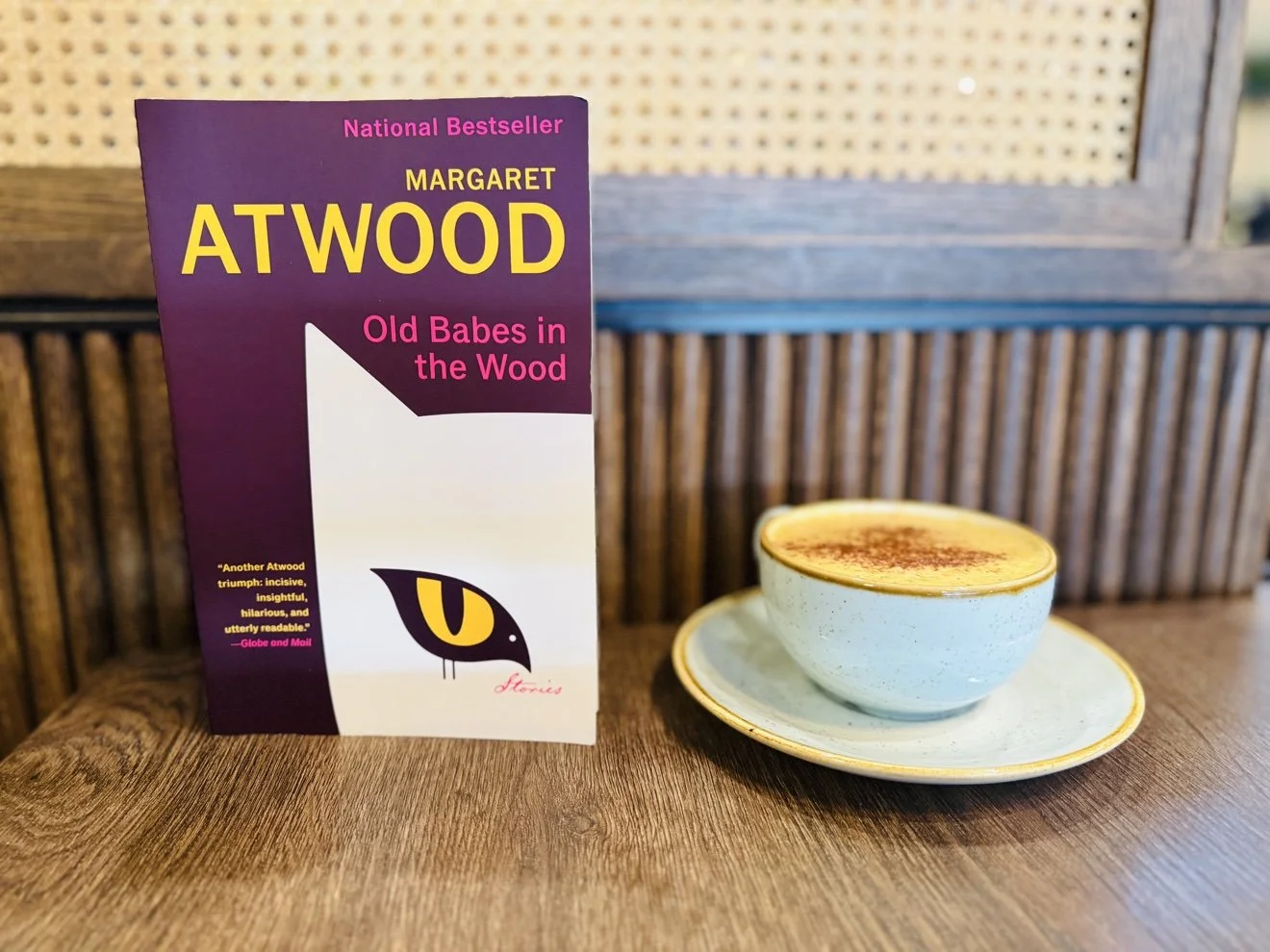
Review: 2.5 stars
This was my university girls' book club pick, and I'll be honest, it was not a fan favorite. Not mine either, though a 3-star Atwood is still Atwood.
The collection is bookended by the Tig and Nell stories, which follow an elderly married couple across a lifetime together and then Nell alone after Tig is gone. I found those sections slow-moving...but slow the way grief is slow, I suppose. There were genuinely poignant flashes, and I could feel what she was doing: an aging writer working through widowhood, her own fears of old age, the shape of a long marriage once half of it is missing.
The middle eight stories were much more thought provoking - the wild, unboundaried center where Atwood clearly gave herself permission to play. "The Dead Interview" was my favorite: Atwood in conversation with George Orwell from beyond the grave, updating him on the internet, cancel culture, anti-vaxxers, and January 6th, watching the great prophet of totalitarianism try to process our century.
"Impatient Griselda" and "Metempsychosis" were both genuinely funny, and the snail's-eye view in the latter is the kind of idea only Atwood would commit to: a soul transplanted from snail to human discovering that human life is the worse deal, including all the indignities of a body. And "Freeforall" was the most Handmaid's Tale of the bunch: take one idea to its extreme, how do we keep the pure from the infected, and watch the entire social architecture, the lore, the Houses, rise up around a single distinction.
But stitched together, the collection is hard to pull a thread through without requiring over-analysis. The form gave Atwood enormous liberty; she could write whatever she wanted, in whatever order, and the cost is unevenness. The middle stories don't obviously talk to each other, or to the bookends, and I kept wishing for more continuity.
The exception, the story I'll actually remember, is "Wooden Box." Widowed Nell sorting through Tig's things, ambushed by the smallest memory, and suddenly right back in the depths of it. That ability to take a universal truth (grief lives in objects and it strikes wherever you are) and make you feel it so precisely, so deeply. That wasn't muted at all by my feelings about the book. If anything, it showed her prowess more clearly - Atwood in a small, quiet moment, doing what almost nobody else can do.