• Booklish
  • Index
  • Blog
  • Shelf
  • About
  • Ratings
  • Contact
Menu

Booklish

Delectable reads for bibliophiles
  • Booklish
  • Index
  • Blog
  • Shelf
  • About
  • Ratings
  • Contact

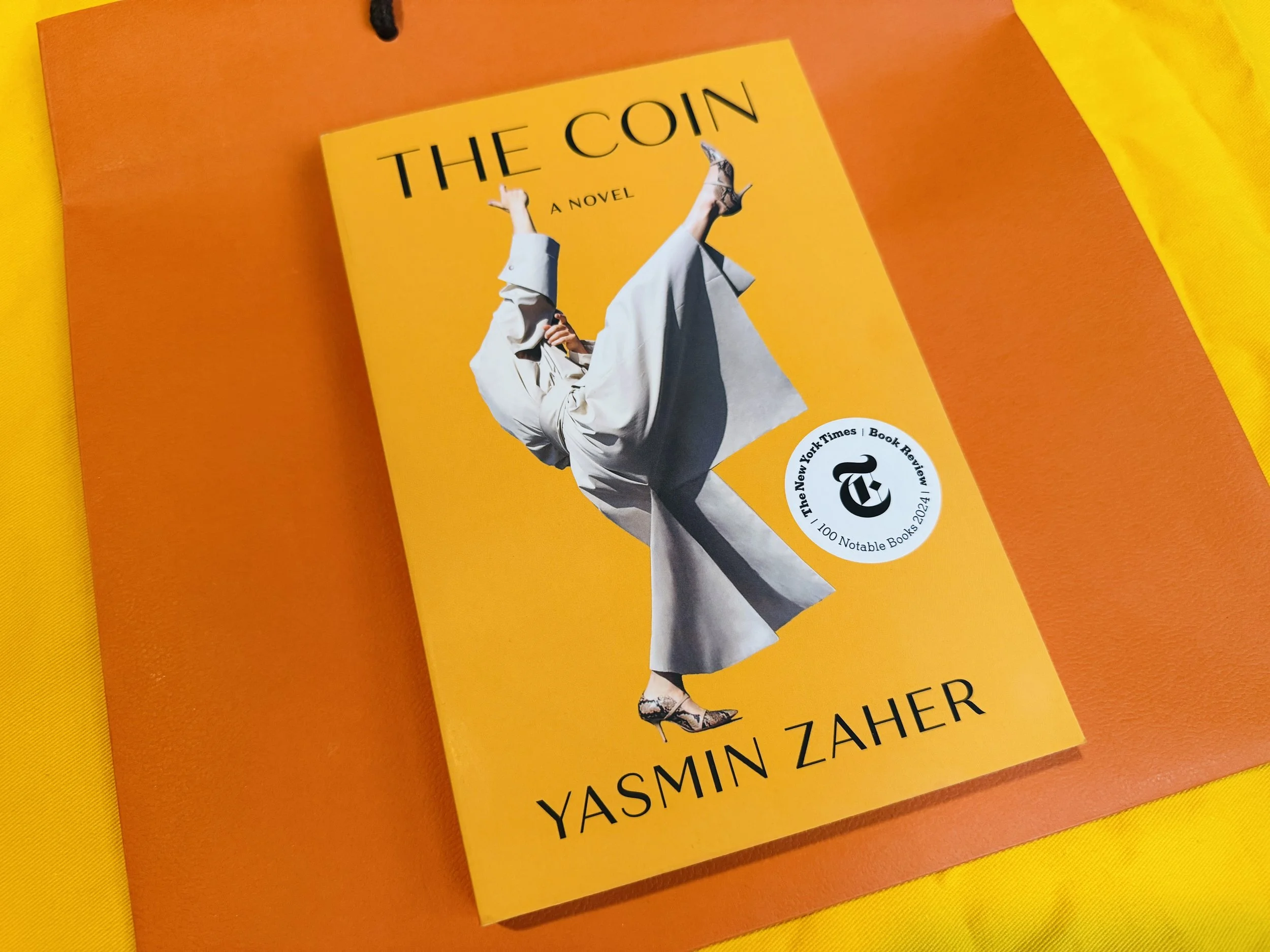
‘The Coin’ by Yasmin Zaher

The Coin

January 12, 2026

Rating: 4.5 stars

As I was flying out of SFO over winter break, I stopped by Compass Books, a well-curated Barnes & Noble independent offshoot. While my kids roamed around, I made my way through the fiction section and came across The Coin. In one simple word, it was fabulous.

The Coin follows a young Palestinian woman living in New York, whose life begins to unravel as her relationship to money, cleanliness, beauty, and power turns increasingly obsessive. Through her work as a teacher and her entanglements with wealth and luxury, the novel examines how identity fractures when control becomes a substitute for meaning.

The novel feels deliberately deranged—a controlled descent into obsession. Zaher fixates on filth and cleanliness and on the unbearable discomfort of believing there is a coin lodged inside her body, resisting logic or medical resolution. The narrator’s CVS Retreat ritual of scrubbing her body for several hours with multiple drugstore detergents, is her attempt at treatment. Her descriptions of curdled skin, soap, dirt, and residue after a bath are visceral - the refuse is her. Why do we become disgusted by what has molted from our bodies, when moments earlier it was an invisible layer inseparable from the self? “I was flushed, clean. I had shed what needed to be shed. At the end of the day it was just garbage. But I had oiled and spiced it up like it was a celebratory leg of lamb.”Paradoxically, as her cleaning compulsions intensify, she begins to intentionally soil both her physical appearance and her reputation.

The coin itself becomes the quiet center of the novel: a lodged object that refuses to be expelled. It represents what cannot be scrubbed away—trauma, class anxiety, displacement, the uneasy inheritance of money and power. Her fixation on cleanliness feels less about hygiene than about control, the hope that if every contaminant is eliminated, something unbearable inside her might finally disappear. The novel insists otherwise.

She moves through men she does not love, yet allows herself to be used, despite her apparent fluency in beauty, class, and their unspoken rules. That contradiction comes into focus with Trenchcoat, a luxury-goods arbitrager she pursues romantically. Through him, she enters a Hermès resale scheme governed by a logic that feels more fixed than nature itself: “Every year, regardless of poverty, war, or famine, the price of the Birkin bag increases.” What begins as satire settles into something colder—luxury as a closed system, impervious to consequence.

The novel reminded me of The Bell Jar—another young woman’s attempt to understand herself beyond accepted norms. While it was gendered expectation for Esther Greenwood’s character, for our narrator in The Coin, wealth, fashion, and education are the catalysts of her undoing. Later on in the novel, the garden she transforms her apartment into becomes an attempt at rebirth. She tries to become one with the earth, and as a reader you feel the devastation of beauty returning to something plain and repulsive. What begins vibrant and alive decays into an odorous heap of rot. Growth and decay are inseparable.

Overall, the writing is compulsively readable and frequently shocking. It reads as if Vogue briefly lost its mind, descended into literary madness, and then re-emerged without explanation. Zaher captures the absurdity of class, the intimacy of obsession, and the uncomfortable truth that self-knowledge does not always arrive gently, or leave us intact.

In fiction Tags strong female lead, palestine, new york city, NYT notable book, identity, 4.5 stars, classism
Comment

‘Hot Milk’ by Deborah Levy

Hot Milk

May 2, 2024

Review: 4 stars

I love browsing bookstores, especially with my sisters. On a trip to Toronto last fall, my older sister shared some of her favourite reads with me as we were perusing the stacks at Type Books on Queen. The one that got me intrigued was ‘Hot Milk’ by Deborah Levy. Shortlisted for the 2016 Man Booker, the novel follows Sofia and her mother Rose, on their Hail Mary journey to Almería, Spain for a cure for Rose’s mysterious limb paralysis.

In the opening pages, we learn that 25-year old Sofia is being inducted into adulthood, awash in the jarring taste of one’s first major failure. “The dream is over for me. It began when I left my lame mother alone to pick the pears from the tree in our East London garden that autumn I packed my bags for university…It ended when she became ill and I abandoned my Ph.D.” Over the course of the novel, we see Sofia become the foil to her previous self as she wades into new shapes and forms of being. She changes her occupation from ‘Waitress’ to ‘Monster’ on a health intake form over subsequent visits to a seaside first-aid hut. The stifling heat, incessant jellyfish stings and her pent up madness and desire have swirled into a combustible being. Sofia has emerged anew. She triumphantly frees a murderous dog from an abusive owner, takes a first aid student to be a lover and then takes Ingrid, a seamstress and her muse, also as a lover.

The irresistible tide of the Andalusian pilgrimage sucks Sofia in and upends the predictable prison she has created in her mind and the physical constraints of being her mother’s legs. At one point, Rose considers amputation to rid herself of the limbs that fail her. In actuality, her limbs are already severed from her, yet tethered to her - Sofia is her only source of mobility. A daughter as an extension, yet separation of one’s own self. As the novel reaches its conclusion, the severance becomes permanent - mother and daughter are more estranged than ever. One living an ever smaller, shorter, boxed-in life, and the other bursting with possibility, melted by the hot Spanish sun into something malleable, finding its organic shape day by day.

The writing is gorgeous, experimental and bold. Passages read like poetry, and Levy plays with form throughout - bulleted lists punctuate chapters, as do grammar-defying lines such as “I was flesh thirst desire dust blood lips cracking feet blistered knees skinned hips bruised”. Just like hot milk, the writing froths over the reader, with only a pale residue remaining long past the last page, a stubborn mark that refuses to be forgotten. A searing, complex and enthralling read.

In fiction Tags LGBTQ, man booker prize, womanhood, spain, NYT notable book, 4 stars, coming of age

Normal People by Sally Rooney

Normal People

June 12, 2021

Review: 4 stars

It’s certainly been a while since I last had a chance to post! Life with two kids and return to work (albeit remote), has been more than a handful. But I feel lucky that we have so far emerged unscathed from the pandemic - that in itself is a blessing!

I was looking for a new show to watch on weekends to unwind a bit, and came across ‘Normal People’ - the BBC and Hulu adaptation of Sally Rooney’s sophomore novel. It inspired me to share my reflections on the source material, which I had read earlier in 2020.

Many find the book “compulsive” and “difficult to put down” - certainly, I echo these sentiments, particularly when Marianne and Connell, our star-crossed protagonists, are in the thralls of their adolescent, tormented romance. What I found most striking though, was the brutally honest, yet somehow misunderstood dialogue between the two of them, and more importantly, the dialogue each had internally with their own self. Connell’s hidden anxieties and fear of conspicuousness drive him to create a divided universe. One of his high school hallways, where he passively watches as Marianne is harshly bullied, and another of his bedroom, where he is mentally and physically entranced by Marianne. He deludes himself in his level of self-importance, believing he has the power to upend the social hierarchy of high school if he admits to his secret affair with Marianne. Connell’s need for self-preservation leads to a painful betrayal, and the first of many scars inflicted upon the fragile, rare bond he shares with Marianne.

I followed the unfolding saga avidly - cursing their ability to completely speak past one another, and amazed by their ability to share absolute truths in an entirely disarming way. They become two magnets that are inexorably drawn together, but monetary woes, controlling boyfriends and their own self-doubt continue to cast polarizing forcefields around them, drawing them apart time and again. Rooney is so skillful in her ability to reflect real relationships - the wounds pile up, are momentarily salved, but the scars and memory of the pain layer upon one another. I found myself yearning for a return to wholeness, perfection and innocence - they way they once were. This does not transpire - Rooney takes each character further into flawed darkness - Connell with depression, Marianne with abusive relationships. The two people who return to one another by the end of the novel are like well-worn puzzle pieces - frayed and bent at the edges, but with an interlocking centre that enables a perfect fit.

The restorative power of relationships - especially the ones that transform and heal your core - is another beautiful theme that Rooney explores. Connell’s steadfast love for Marianne, from affirmation of her beauty to his refusal to hurt her during their most intimate moments, is the kernel of confidence that Marianne uses to grow her self-worth. By the end, his love for her is fact, not to be debated - something that simply will always be true. His love redeems her from the precipice of being unloveable.

I loved the tone of the novel - sensitive, aloof, free of artifice. It is full of joy and heartbreak, and is a fascinating examination into the lives of two complex, intelligent characters. I hope you have the chance to try this as a more cerebral summer romance read!

In fiction Tags romance, millennial, 4 stars, abuse, mental health, NYT notable book

Latest Posts

Featured
science fiction, apocalypse, LGBTQ, romance, culinary, 4 stars, asian literature
Land of Milk and Honey
science fiction, apocalypse, LGBTQ, romance, culinary, 4 stars, asian literature
strong female lead, palestine, new york city, NYT notable book, identity, 4.5 stars, classism
The Coin
strong female lead, palestine, new york city, NYT notable book, identity, 4.5 stars, classism
war, national book award, palestine, journalism, 5 stars, emotional
One Day, Everyone Will Have Always Been Against This
war, national book award, palestine, journalism, 5 stars, emotional
fiction, mid-life crisis, healing, books, korean lit, 4.5 stars
Welcome to the Hyunam-Dong Bookshop
fiction, mid-life crisis, healing, books, korean lit, 4.5 stars
3 stars, Japanese literature, crime, mystery, love
The Devotion of Suspect X
3 stars, Japanese literature, crime, mystery, love
fantasy, apocalypse, life & death, family, los angeles, magic, 4 stars
Catchpenny
fantasy, apocalypse, life & death, family, los angeles, magic, 4 stars
italian literature, motherhood, marriage, infidelity, identity, strong female lead, 5 stars, family
Forbidden Notebook
italian literature, motherhood, marriage, infidelity, identity, strong female lead, 5 stars, family
LGBTQ, man booker prize, womanhood, spain, NYT notable book, 4 stars, coming of age
Hot Milk
LGBTQ, man booker prize, womanhood, spain, NYT notable book, 4 stars, coming of age
spiritual, BBC 100 Novels, love, mysticism, 4 stars
The Forty Rules of Love
spiritual, BBC 100 Novels, love, mysticism, 4 stars
short stories, science fiction, apocalypse, asian literature, 3 stars
Your Utopia
short stories, science fiction, apocalypse, asian literature, 3 stars